


Contributors

Adam Frank

Managing Director, Head of Wealth Planning and Advice, J.P. Morgan Wealth Management

Holding investments through short-term volatility and not trying to time the market is generally prudent, but tax-loss harvesting could enhance your after-tax returns.

As many investors know, not all investments can be outperformers all the time. But there may be a silver lining: Your losses may actually help lower your tax bill thanks to a tax strategy known as tax-loss harvesting.

Of course, you should plan in advance and consult a tax professional to ensure this strategy is a good fit. Here are some considerations:

What is tax-loss harvesting?

Tax-loss harvesting involves selling securities at a loss, or in other words, securities that are currently worth less than what you bought them for. Once you sell these securities, the losses may be able to offset capital gains from other parts of your portfolio. They could also help offset gains from other capital assets you own for which you have realized, or may want to realize, taxable gain.

If done properly, tax-loss harvesting can reduce or eliminate capital gains tax on gains you realize within the same tax year. What’s more, someone with more capital losses than capital gains in a tax year can use up to $3,000 of the unused losses to offset ordinary income and can carry forward unused losses to offset future capital gains.

How tax loss harvesting works

Let's say you invested $1,000 in stock A. Over the course of a month, it loses $400 in value
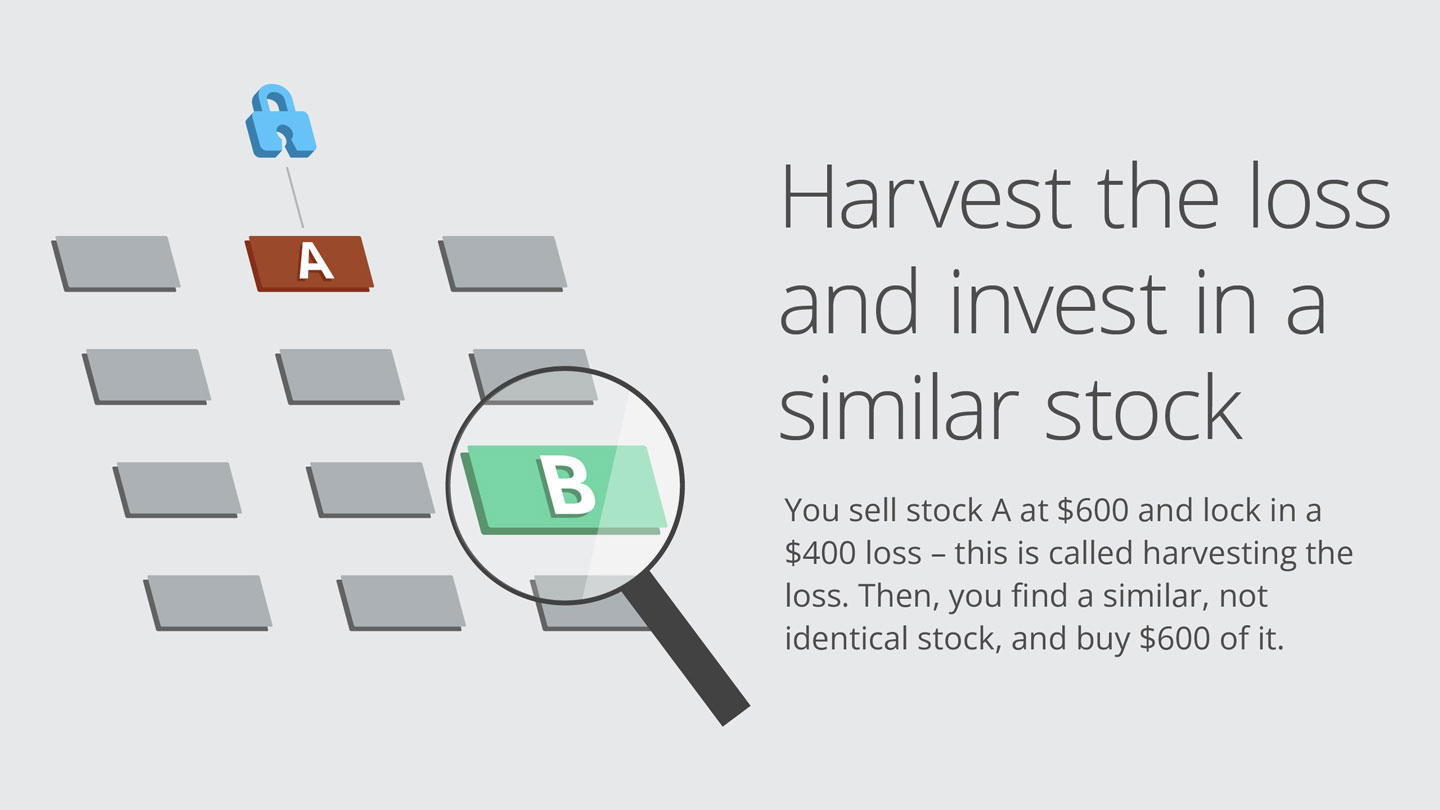
You sell stock A at $600 and lock in a $400 loss - this is called harvesting the loss. Then, you find a similar, not identical stock, and buy $600 of it.
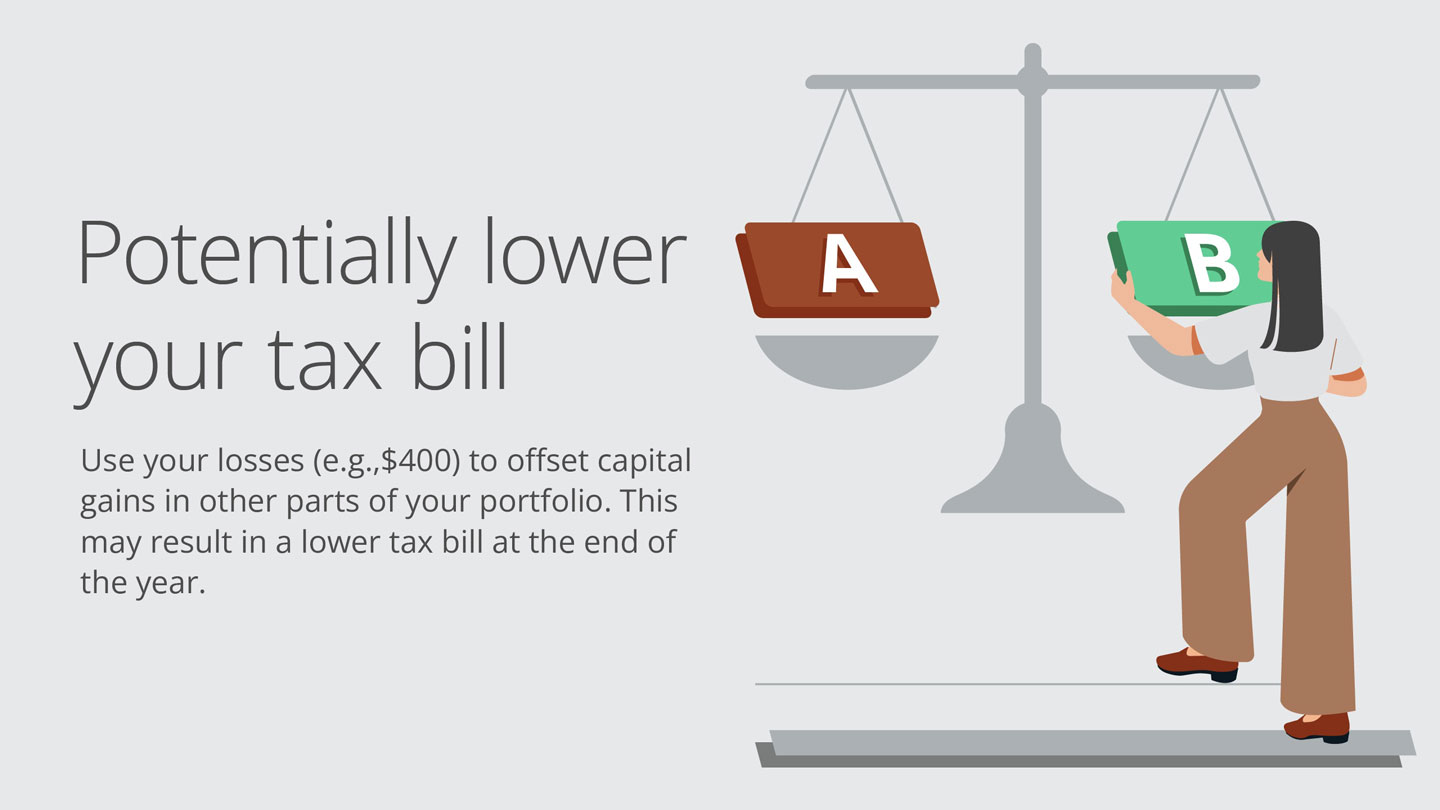
Use your losses (e.g., $400) to offset capital gains in other parts of your portfolio. This may result in a lower tax bill at the end of the year.

Beware of “wash sales”

It is possible to repurchase a security you’ve sold.  Just be careful not to trigger a “wash sale,” which will cause your loss to be disallowed in the year it is realized.

Generally speaking, a wash sale occurs when you sell a security at a loss and purchase a “substantially identical” replacement security within 30 days before or 30 days after the sale date.

If you purchase a substantially identical replacement security within this time period, the loss will be disallowed. The disallowed loss is generally added to the tax basis of the replacement security, meaning the loss will be deferred until you sell the replacement. To illustrate, if you sell stock at a loss on December 1, the wash-sale rule could be triggered if you buy a replacement security any time between November 1 and December 31. Special rules may apply in cases where some, but not all, of the shares of the original security are sold. 

What is a replacement security?

A replacement security doesn’t have to be exactly identical to the security you sold to trigger a wash sale. Rather, a replacement security is deemed “substantially identical” to the security it is replacing; in other words, it’s a security so similar to the one being replaced that the IRS doesn’t differentiate between the two. Following this, a wash sale can be triggered if a replacement security is deemed substantially identical. For example, if you sell a stock at a loss, a wash sale can be triggered if you repurchase the same stock, a call option on the same stock or a number of other securities that are similar enough to be considered substantially identical to the sold stock.

To illustrate, if you sell a bond for a loss, the more different your replacement bond is (e.g., maturity date, coupon, etc.), the more likely it is that your loss will be allowed and that the replacement bond won’t trigger a wash sale. Consider consulting with your tax advisor to determine whether a replacement security may be “substantially identical” to the security you sold.

How can you remain exposed to the market without triggering a wash sale?

You can purchase a substitute that isn’t substantially identical to the security you sold. Possible substitutes may be stocks that trade similarly (e.g., you sell a consumer staples stock for a loss and purchase a different consumer staples stock to replace it), or market proxies (e.g., you sell a large-cap U.S. stock for a loss and purchase an index fund or exchange-traded fund that follows the appropriate index), so long as such substitutes are not “substantially identical.”

You can also “double up” (i.e., purchase twice as much) on the security more than 30 days before you intend to sell it – and keep the newly purchased portion – or you can wait for at least 30 days after you sell it to repurchase it. Since doubling up increases your exposure to the security for the period before you sell the loss portion, you need to be sure that this increased concentration makes sense for you.

Note that if any of the replacement securities appreciate in value, and you sell them before you have held them for over a year, any capital gains will be short-term and therefore taxed at ordinary income rates.

Getting started

There are a variety of ways in which tax-loss harvesting can be incorporated into your portfolio, whether you harvest losses on a periodic basis yourself, choose to automate the process, or work with an advisor who can implement the strategy for you. In any case, you’ll want to coordinate with your tax professional to make sure you can benefit from any method that you consider. 

Connect with a Wealth Advisor

Reach out to your Wealth Advisor to discuss any considerations for your current portfolio. If you don’t have a Wealth Advisor, click here to tell us about your needs and we’ll reach out to you.

Connect now

IMPORTANT INFORMATION

This material is for informational purposes only, and may inform you of certain products and services offered by J.P. Morgan’s wealth management businesses, part of JPMorgan Chase & Co. (“JPM”). Products and services described, as well as associated fees, charges and interest rates, are subject to change in accordance with the applicable account agreements and may differ among geographic locations. Not all products and services are offered at all locations. If you are a person with a disability and need additional support accessing this material, please contact your J.P. Morgan team or email us at accessibility.support@jpmorgan.com for assistance. Please read all Important Information.

The impact of a tax loss harvesting strategy depends upon a variety of conditions, including the actual gains and losses incurred on holdings and future tax rates.

Tax loss harvesting may not be appropriate for everyone.  If you do not expect to realize net capital gains this year, have net capital loss carryforwards, are concerned about deviation from your model investment portfolio, and/or are subject to low income tax rates or invest through a tax-deferred account, tax loss harvesting may not be optimal for your account. You should discuss these matters with your investment and tax advisors.


GENERAL RISKS & CONSIDERATIONS
Any views, strategies or products discussed in this material may not be appropriate for all individuals and are subject to risks. Investors may get back less than they invested, and past performance is not a reliable indicator of future results. Asset allocation/diversification does not guarantee a profit or protect against loss. Nothing in this material should be relied upon in isolation for the purpose of making an investment decision. You are urged to consider carefully whether the services, products, asset classes (e.g. equities, fixed income, alternative investments, commodities, etc.) or strategies discussed are suitable to your needs. You must also consider the objectives, risks, charges, and expenses associated with an investment service, product or strategy prior to making an investment decision. For this and more complete information, including discussion of your goals/situation, contact your J.P. Morgan representative.

NON-RELIANCECertain information contained in this material is believed to be reliable; however, JPM does not represent or warrant its accuracy, reliability or completeness, or accept any liability for any loss or damage (whether direct or indirect) arising out of the use of all or any part of this material. No representation or warranty should be made with regard to any computations, graphs, tables, diagrams or commentary in this material, which are provided for illustration/reference purposes only. The views, opinions, estimates and strategies expressed in this material constitute our judgment based on current market conditions and are subject to change without notice. JPM assumes no duty to update any information in this material in the event that such information changes. Views, opinions, estimates and strategies expressed herein may differ from those expressed by other areas of JPM, views expressed for other purposes or in other contexts, and this material should not be regarded as a research report. Any projected results and risks are based solely on hypothetical examples cited, and actual results and risks will vary depending on specific circumstances. Forward-looking statements should not be considered as guarantees or predictions of future events.

Nothing in this document shall be construed as giving rise to any duty of care owed to, or advisory relationship with, you or any third party. Nothing in this document shall be regarded as an offer, solicitation, recommendation or advice (whether financial, accounting, legal, tax or other) given by J.P. Morgan and/or its officers or employees, irrespective of whether or not such communication was given at your request. J.P. Morgan and its affiliates and employees do not provide tax, legal or accounting advice. You should consult your own tax, legal and accounting advisors before engaging in any financial transactions.

Legal Entity and Regulatory Information.

J.P. Morgan Wealth Management is a business of JPMorgan Chase & Co., which offers investment products and services through J.P. Morgan Securities LLC (JPMS), a registered broker-dealer and investment adviser, member FINRA and SIPC. Insurance products are made available through Chase Insurance Agency, Inc. (CIA), a licensed insurance agency, doing business as Chase Insurance Agency Services, Inc. in Florida. Certain custody and other services are provided by JPMorgan Chase Bank, N.A. (JPMCB). JPMS, CIA and JPMCB are affiliated companies under the common control of JPMorgan Chase & Co. Products not available in all states.

Bank deposit accounts and related services, such as checking, savings and bank lending, are offered by JPMorgan Chase Bank, N.A. Member FDIC.

This document may provide information about the brokerage and investment advisory services provided by J.P. Morgan Securities LLC (“JPMS”). The agreements entered into with JPMS, and corresponding disclosures provided with respect to the different products and services provided by JPMS (including our Form ADV disclosure brochure, if and when applicable), contain important information about the capacity in which we will be acting. You should read them all carefully. We encourage clients to speak to their JPMS representative regarding the nature of the products and services and to ask any questions they may have about the difference between brokerage and investment advisory services, including the obligation to disclose conflicts of interests and to act in the best interests of our clients.

J.P. Morgan may hold a position for itself or our other clients which may not be consistent with the information, opinions, estimates, investment strategies or views expressed in this document.  JPMorgan Chase & Co. or its affiliates may hold a position or act as market maker in the financial instruments of any issuer discussed herein or act as an underwriter, placement agent, advisor or lender to such issuer.