

Key takeaways

  • Many of 2026’s tax code changes are the result of the One Big Beautiful Bill Act, which was passed in July 2025.
  • In addition, the SECURE 2.0 Act brought changes to 401(k) catch-up contributions.
  • Now is a good time to review all the changes and make sure your 2026 financial plan is optimized.

Contributors

Adam Frank

Managing Director, Head of Wealth Planning and Advice, J.P. Morgan Wealth Management

[gentle electronic music]

On screen:

This video opens with a silver-haired man in a dark blazer, sitting at a table in an office with curtains and wood shelving. A J.P. Morgan Wealth Management logo remains in the corner. Identifying text appears beside him: 'Adam Frank, Head of Wealth Planning and Advice, J.P. Morgan Wealth Management.'

On screen:

Adam Frank

Head of Wealth Planning and Advice

J.P. Morgan Wealth Management

Adam Frank:

Hi, I'm Adam Frank. I lead J.P. Morgan's Wealth Planning and Advice team, and I'm here to talk to you about three major tax changes brought about by the One Big Beautiful Bill Act that could have a significant impact on your financial plans. I promise to keep things simple and quick, so, let's dive in.

On screen:

Text appears over white:

On screen:

1

Permanent Extension of the key TCJA (Tax Cuts & Jobs Act) Provisions

Adam Frank:

Big news: Major tax rules that were set to expire at the end of 2025 have been extended permanently. They're here to stay. The top income tax rate is set at 37%...

On screen:

Text boxes read:

On screen:

Top income tax rate is fixed at 37%

Estate, Gift, Generation-Skipping Transfer tax exemption is fixed at $15 million

On screen:

More text appears over white:

On screen:

2

SALT Cap Increase

Adam Frank:

...and the exemption from estate gift and generation-skipping transfer tax is $15 million. Here's a change that could make a real difference for people who itemize their deductions. Through the end of 2028, the deduction for state and local income taxes increases from $10,000 to $40,000.

On screen:

A text box reads:

On screen:

Cap rises to $40,000 (2025-2028)

On screen:

It continues:

On screen:

Phased down to $10,000 for high earners

Adam Frank:

Keep in mind that high income earners have a phaseout back down to $10,000. This could impact how you approach your deductions and overall tax planning.

On screen:

More text appears over white:

On screen:

3

New 0.5% Floor on Charitable Deductions

Adam Frank:

If giving back is important to you, here's something to keep in mind. New rules beginning in 2026 will limit the tax benefit of charitable donations. If you itemize, your charitable deduction will be subject to a floor of half a percent of your adjusted gross income.

On screen:

A text box reads:

On screen:

Charitable deduction will be 0.5% of AGI if itemized

On screen:

It continues:

On screen:

Benefit of deduction will be capped at 35%

Adam Frank:

And if you're in the 37% tax bracket, the benefit of the deduction will be capped at 35%. But the good news, if you don't itemize, is that the bill introduced an above-the-line deduction of up to $1,000 for single taxpayers and up to $2,000 for married couples filing jointly for cash gifts made to qualified public charities, which doesn't include donor-advised funds.

On screen:

Text boxes read:

On screen:

'If no itemization, deduction of up to $1,000 for single taxpayers

and $2,000 for married couples filing jointly

On screen:

A logo appears over white:

Logo:

J.P. Morgan Wealth Management.

On screen:

Text below reads:

On screen:

Take control of your wealth journey. Schedule a conversation with a J.P. Morgan Advisor to build a strategy that's tailored just for you.

Adam Frank:

Take control of your wealth journey. Schedule a conversation with a J.P. Morgan Advisor to build a strategy that's tailored just for you.

On screen:

A URL in a tan text box reads:

On screen:

'JPMORGAN.COM/WEALTHPARTNERS'

Side note:

Legal disclosures begin in bold:

On screen:

(In bold) 'IMPORTANT INFORMATION. JPMorgan Chase & Co., its affiliates, and employees do not provide tax, legal or accounting advice. This material has been prepared for informational purposes only, and is not intended to provide, and should not be relied on for tax, legal and accounting advice. You should consult your personal tax, legal and accounting advisors before engaging in any financial transaction.'

Side note:

Disclosures continue:

On screen:

This material is for information purposes only and may inform you of certain products and services offered by J.P. Morgan's wealth management businesses, part of JPMorgan Chase & Co. ("JPM"). The views and strategies described in the material may not be suitable for all investors and are subject to investment risks. Please read all Important Information.

(In bold) GENERAL RISKS & CONSIDERATIONS. Any views, strategies or products discussed in this material may not be appropriate for all individuals and are subject to risks. Investors may get back less than they invested, and past performance is not a reliable indicator of future results.Asset allocation/diversification does not guarantee a profit or protect against loss. Nothing in this material should be relied upon in isolation for the purpose of making an investment decision. You are urged to consider carefully whether the services, products, asset classes (e.g. equities, fixed income, alternative investments, commodities, etc.) or strategies discussed are suitable to your needs. You must also consider the objectives, risks, charges, and expenses associated with an investment service, product or strategy prior to making an investment decision. For this and more complete information, including discussion of your goals/situation, contact your J.P. Morgan representative.

(In bold) NON-RELIANCE. Certain information contained in this material is believed to be reliable; however, JPM does not represent or warrant its accuracy, reliability or completeness, or accept any liability for any loss or damage (whether direct or indirect) arising out of the use of all or any part of this material. No representation or warranty should be made with regard to any computations, graphs, tables, diagrams or commentary in this material, which are provided for illustration/reference purposes only. The views, opinions, estimates and strategies expressed in this material constitute our judgment based on current market conditions and are subject to change without notice. JPM assumes no duty to update any information in this material in the event that such information changes. Views, opinions, estimates and strategies expressed herein may differ from those expressed by other areas of JPM, views expressed for other purposes or in other contexts, and this material should not be regarded as a research report. Any projected results and risks are based solely on hypothetical examples cited, and actual results and risks will vary depending on specific circumstances. Forward-looking statements should not be considered as guarantees or predictions of future events.

Nothing in this document shall be construed as giving rise to any duty of care owed to, or advisory relationship with, you or any third party. Nothing in this document shall be regarded as an offer, solicitation, recommendation or advice (whether financial, accounting, legal, tax or other) given by J.P. Morgan and/or its officers or employees, irrespective of whether or not such communication was given at your request. J.P. Morgan and its affiliates and employees do not provide tax, legal or accounting advice. You should consult your own tax, legal and accounting advisors before engaging in any financial transactions.

(In bold) LEGAL ENTITY AND REGULATORY INFORMATION. J.P. Morgan Wealth Management is a business of JPMorgan Chase & Co., which offers investment products and services through (in bold) J.P. Morgan Securities LLC (JPMS), a registered broker-dealer and investment adviser, member FINRA and SIPC. Insurance products are made available through Chase Insurance Agency, Inc. (CIA), a licensed insurance agency, doing business as Chase Insurance Agency Services, Inc. in Florida. Certain custody and other services are provided by JPMorgan Chase Bank, N.A. (JPMCB). JPMS, CIA and JPMCB are affiliated companies under the common control of JPMorgan Chase & Co. Products not available in all states.

Bank deposit accounts and related services, such as checking, savings and bank lending, are offered by JPMorgan Chase Bank, N.A. Member FDIC.

This document may provide information about the brokerage and investment advisory services provided by (in bold) J.P. Morgan Securities LLC ("JPMS"). The agreements entered into with JPMS, and corresponding disclosures provided with respect to the different products and services provided by JPMS (including our Form ADV disclosure brochure, if and when applicable), contain important information about the capacity in which we will be acting. You should read them all carefully. We encourage clients to speak to their JPMS representative regarding the nature of the products and services and to ask any questions they may have about the difference between brokerage and investment advisory services, including the obligation to disclose conflicts of interests and to act in the best interests of our clients.

J.P. Morgan may hold a position for itself or our other clients which may not be consistent with the information, opinions, estimates, investment strategies or views expressed in this document. JPMorgan Chase & Co. or its affiliates may hold a position or act as market maker in the financial instruments of any issuer discussed herein or act as an underwriter, placement agent, advisor or lender to such issuer.


Copyright ©2026 JPMorgan Chase & Co. All rights reserved.


While a new year in many cases brings new tax updates, some years bring more changes than others. Many Americans have been especially watchful of 2026, when 2017’s Tax Cuts and Jobs Act (TCJA) provisions were set to expire.

If that had happened, tax rates would have increased while the standard deduction would have been slashed. New legislation was passed in summer 2025, though, locking in the savings many taxpayers had grown accustomed to – and introducing some new changes as well.

Read on to learn more about some of the key tax changes for 2026.

What changes are happening to the tax code in 2026?

The IRS makes annual inflation adjustments to more than 60 tax provisions, including tax bracket income thresholds, standard deductions and retirement contribution limits.1 While these routine adjustments will occur as usual for tax year 2026, recently passed legislation will also introduce some additional changes.

The One Big Beautiful Bill Act and its impact on the 2026 tax code

Passed in July 2025, the One Big Beautiful Bill Act (OBBBA) made sweeping updates to the U.S. tax code. The primary impact was the permanent extension of many TCJA provisions, including lower tax rates and higher standard deduction amounts. The OBBBA included other changes as well, such as new deductions for tips, overtime, car loan interest and charitable contributions. It also provided an increased deduction for state and local taxes (SALT).2 Eligible Americans will be able to claim these starting in 2026.

The SECURE 2.0 Act and its impact on 2026 taxes

The Setting Every Community Up for Retirement Enhancement (SECURE) 2.0 Act is also worth noting. This federal law, enacted in 2022, included more than 90 provisions aimed at expanding retirement plan coverage. Two of those changes will affect 2026 taxes: the addition of increased catch-up contribution limits for individuals ages 60–63 and requirements that catch-up contributions for designated high earners be made on an after-tax Roth basis.3

How much will the standard tax deduction and tax brackets change in 2026?

The TCJA nearly doubled the standard deduction and lowered tax rates across the seven-bracket structure.4 Thanks to the OBBBA, both of these provisions will continue into 2026, albeit with the following adjustments for inflation.

Standard tax deduction amounts by filing status

The standard deduction amounts for 2026 are as follows:

  • Single: $16,100, up from $15,750 in 2025.
  • Married filing separately: $16,100, up from $15,750 in 2025.
  • Married filing jointly: $32,200, up from $31,500 in 2025.
  • Surviving spouses: $32,200, up from $31,500 in 2025.
  • Heads of household: $24,150, up from $23,625 in 2025.5

Furthermore, taxpayers age 65 and over may qualify for an additional deduction of up to $6,000 in 2026; however, these individuals must meet specific income and filing status requirements.6

Tax brackets by income group

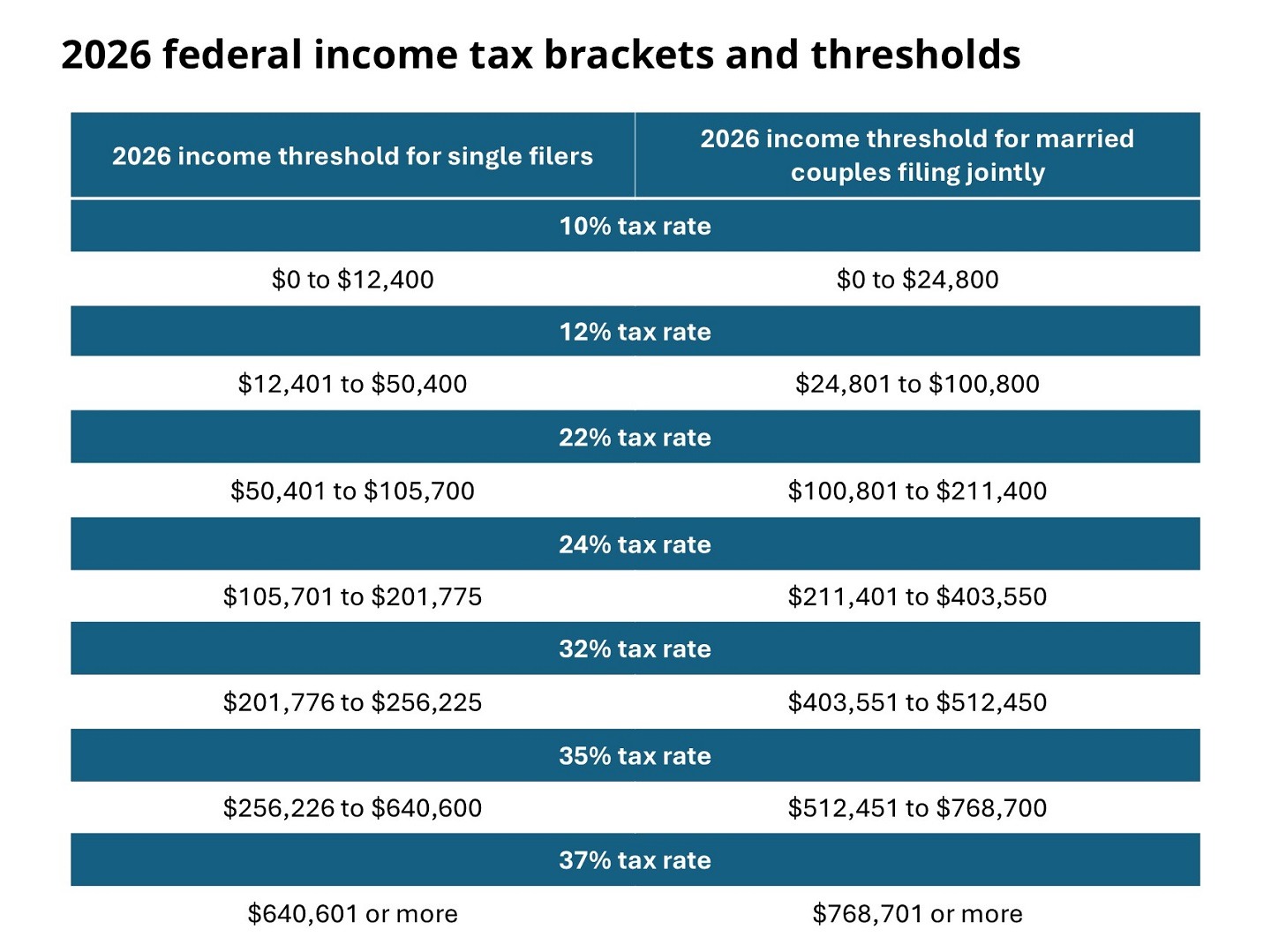
While the 2026 tax rates aren’t changing from tax year 2025, the income thresholds for each tax bracket will be adjusted as follows.7

This table shows the 2026 federal income tax brackets and thresholds.


What’s new for retirement contributions, tax deductions and tax credits in 2026?

Beyond adjustments to tax brackets and standard deductions, here are some other key changes you should know about for tax year 2026.

401(k) catch-up contribution rules have changed

As mentioned, the SECURE 2.0 Act made several changes to 401(k) catch-up contributions that will impact certain taxpayer segments in the coming year. First, the IRS now allows 401(k) plan holders ages 60 to 63 to make “super” catch-up contributions. In 2026, the regular catch-up contribution limit is $8,000, while the higher catch-up limit available to individuals 60–63 is $11,250.8 Contributing more to your 401(k) on a pre-tax basis can help reduce your taxable income for the year, so plan participants who are eligible for the super catch-up limit could stand to benefit not only from boosted contributions but also from a lower tax bill. Plan providers are not required to offer the higher limit, however, so availability of the super catch-up limit will vary by plan.

Additionally, 401(k) plan participants with annual incomes over a newly set threshold will be able to make catch-up contributions on a Roth basis only. Because these high earners will no longer qualify for pre-tax catch-up contributions, which help lower one’s taxable income for the year, their taxable income could effectively increase. The benefit for high earners contributing their catch-up to their 401(k) only on a Roth basis, then, is that qualified withdrawals of their Roth assets in retirement will be tax-free. The current income limit for pre-tax catch-up contributions is set at $145,000 of prior year FICA (Federal Insurance Contributions Act) wages from the employer sponsoring the retirement plan.9

New tax deductions for 2026

The OBBBA also brought about several new deductions that will apply in 2026, including the following:

  • Tip deduction: Taxpayers who work in occupations that customarily receive tips can deduct up to $25,000 in qualified tips per year. Deduction phaseouts apply once single filers earn $150,000 and joint filers earn $300,000.
  • Overtime deduction: Taxpayers who receive qualified overtime compensation can deduct up to $12,500 in overtime pay ($25,000 for joint filers). Deduction phaseouts apply once single filers earn $150,000 and joint filers earn $300,000.
  • Car loan interest deduction: Taxpayers can deduct up to $10,000 of interest paid on a loan for a qualifying vehicle. Deduction phaseouts apply once single filers earn $100,000 and joint filers earn $200,000.10
  • Charity deduction: Taxpayers who take the standard deduction can now take an above-the-line deduction for charitable contributions of up to $1,000 for single filers and $2,000 for joint filers.11
  • SALT deduction cap: The SALT deduction cap in 2026 is $40,400 ($20,200 for filers who are married and filing separately). Deduction phaseouts begin once single filers earn $505,000 and married individuals filing separately earn $252,500.12

Other credits, caps and exclusions for 2026

Lastly, tax year 2026 will see changes to various other credits, including the following:

  • Earned Income Tax Credit (EITC): The maximum EITC in 2026 is $8,231, up from $8,046 in 2025.
  • Lifetime gift and estate tax credits: The exemption amount increases to $15 million in 2026, up from $13.99 million in 2025.
  • Adoption credits: The maximum credit for adoption expenses is increasing to $17,670 from $17,280 in 2025; $5,120 is refundable.
  • Alternative Minimum Tax exemption amounts: The exemption amount is $90,100 for unmarried filers and $140,200 for married couples filing jointly.
  • Foreign earned income exclusion: The maximum exclusion amount on foreign earned income is increasing to $132,900 in 2026, up from $130,000 in 2025.
  • Gift exclusions to noncitizen spouses: Individuals can gift up to $194,000 to a spouse who is not a U.S. citizen in 2026, up from $190,000 in 2025.13
  • Qualified charitable distributions (QCDs): For those with traditional (taxable) IRAs (individual retirement accounts), QCDs up to a certain amount can effectively replace required minimum distributions (RMDs). This type of giving strategy may be an option for account holders who don’t rely on RMDs to fund their lifestyle in retirement. For 2026, the total QCD amount that can be excluded from income is $111,000, up from $108,000 in 2025.14

Will the 2026 tax code changes affect your income taxes?

The changes outlined above will likely affect your federal income taxes in one way or another. Nearly 90% of tax filers claim the standard deduction, so the higher deduction amounts will have widespread impacts.15 Additionally, the tax bracket income threshold increases have the potential to impact the tax rates of many filers.

That said, the overall impact of the 2026 tax changes will depend on the deductions, credits, limits and exclusions that apply to you. For example, if you’re 60 years old and plan on making 401(k) catch-up contributions, you may be able to make more pre-tax contributions in 2026, which lowers your taxable income. Further, if you’re working a job where you earn both tips and overtime, you may now qualify for up to $37,500 in additional deductions.

To understand the true impact, though, you’ll need to review each of the changes to determine if and to what degree it applies to your unique financial situation.

How to get more information or help when it comes to your taxes

The U.S. tax code is complicated and ever-changing. If you’d like to learn more, the following resources can help:

  • IRS.gov: The official website of the IRS is full of reliable information. You can find notices of changes, guidance, official forms, calculators, tools and more. The Interactive Tax Assistant is a good place to start.
  • IRS phone support: For general tax questions, you can also call the IRS directly at 1-800-829-1040.
  • Volunteer Income Tax Assistance (VITA): VITA, an IRS-sponsored initiative, offers free basic tax preparation for those who make $67,000 or less, have a disability or speak limited English.
  • Tax Counseling for the Elderly (TCE): TCE, an IRS initiative providing free tax help for taxpayers 60 and older, specializes in questions on pensions and retirement.
  • MilTax: Offered through the Department of Defense, MilTax is a free tax resource for members of the armed forces.
  • Taxpayer Advocate Service (TAS): TAS, an independent organization within the IRS, helps resolve tax issues that can’t be resolved through regular IRS channels.

For personalized guidance, you should also consider speaking with a qualified tax professional, who can ensure you understand the 2026 changes and are well-prepared for the new tax year.

The bottom line

For 2026, the tax rates and standard deduction amounts will be in line with where they’ve been for the past eight years, while many new deductions and higher credits will be available. Employees nearing retirement may also be able to contribute a bit more to their 401(k) plans, although high earners will be restricted to Roth catch-up contributions. Whatever your situation, now is a good time to review the upcoming changes carefully so you can ensure they’re accounted for in your 2026 financial plan.

References

1.

IRS, “IRS Releases Tax Inflation Adjustments for Tax Year 2026, Including Amendments From the One, Big, Beautiful Bill.” (October 9, 2025)

2.

IRS, “One, Big, Beautiful Bill Provisions.” (November 14, 2025)

3.

IRS, “401(k) Limit Increases to $24,500 for 2026, IRA Limit Increases to $7,500.” (November 13, 2025)

4.

Congress.gov, “Economic Effects of the Tax Cuts and Jobs Act.” (April 7, 2025)

5.

IRS, “IRS Releases Tax Inflation Adjustments for Tax Year 2026, Including Amendments From the One, Big, Beautiful Bill.” (October 9, 2025)

6.

IRS, “One, Big, Beautiful Bill Act: Tax Deductions for Working Americans and Seniors.” (July 14, 2025)

7.

IRS, “IRS Releases Tax Inflation Adjustments for Tax Year 2026, Including Amendments From the One, Big, Beautiful Bill.” (October 9, 2025)

8.

Kiplinger, “New SECURE 2.0 Super 401(k) Catch-up Contribution for Ages 60–63.” (November 14, 2025)

9.

Kiplinger, “New SECURE 2.0 Super 401(k) Catch-up Contribution for Ages 60–63.” (November 14, 2025)

10.

IRS, “One, Big, Beautiful Bill Provisions.” (November 14, 2025)

11.

Tax Foundation “Changes to Charitable Giving Under the One Big Beautiful Bill Act.” (November 10, 2025)

12.

Bipartisan Policy Center, “SALT Deduction Changes in the One Big Beautiful Bill Act.” (July 30, 2025)

13.

IRS, “IRS Releases Tax Inflation Adjustments for Tax Year 2026, Including Amendments From the One, Big, Beautiful Bill.” (October 9, 2025)

14.

IRS, “2026 Amounts Relating to Retirement Plans and IRAs, as Adjusted for Changes in Cost-of-Living.” (Accessed December 4, 2025)

15.

Tax Foundation “Changes to Charitable Giving Under the One Big Beautiful Bill Act.” (November 10, 2025)

Connect with a Wealth Advisor

Reach out to your Wealth Advisor to discuss any considerations for your current portfolio. If you don’t have a Wealth Advisor, click here to tell us about your needs and we’ll reach out to you.

Connect now

IMPORTANT INFORMATION

This material is for informational purposes only, and may inform you of certain products and services offered by J.P. Morgan’s wealth management businesses, part of JPMorgan Chase & Co. (“JPM”). Products and services described, as well as associated fees, charges and interest rates, are subject to change in accordance with the applicable account agreements and may differ among geographic locations. Not all products and services are offered at all locations. If you are a person with a disability and need additional support accessing this material, please contact your J.P. Morgan team or email us at accessibility.support@jpmorgan.com for assistance. Please read all Important Information.


GENERAL RISKS & CONSIDERATIONS
Any views, strategies or products discussed in this material may not be appropriate for all individuals and are subject to risks. Investors may get back less than they invested, and past performance is not a reliable indicator of future results. Asset allocation/diversification does not guarantee a profit or protect against loss. Nothing in this material should be relied upon in isolation for the purpose of making an investment decision. You are urged to consider carefully whether the services, products, asset classes (e.g. equities, fixed income, alternative investments, commodities, etc.) or strategies discussed are suitable to your needs. You must also consider the objectives, risks, charges, and expenses associated with an investment service, product or strategy prior to making an investment decision. For this and more complete information, including discussion of your goals/situation, contact your J.P. Morgan representative.

NON-RELIANCECertain information contained in this material is believed to be reliable; however, JPM does not represent or warrant its accuracy, reliability or completeness, or accept any liability for any loss or damage (whether direct or indirect) arising out of the use of all or any part of this material. No representation or warranty should be made with regard to any computations, graphs, tables, diagrams or commentary in this material, which are provided for illustration/reference purposes only. The views, opinions, estimates and strategies expressed in this material constitute our judgment based on current market conditions and are subject to change without notice. JPM assumes no duty to update any information in this material in the event that such information changes. Views, opinions, estimates and strategies expressed herein may differ from those expressed by other areas of JPM, views expressed for other purposes or in other contexts, and this material should not be regarded as a research report. Any projected results and risks are based solely on hypothetical examples cited, and actual results and risks will vary depending on specific circumstances. Forward-looking statements should not be considered as guarantees or predictions of future events.

Nothing in this document shall be construed as giving rise to any duty of care owed to, or advisory relationship with, you or any third party. Nothing in this document shall be regarded as an offer, solicitation, recommendation or advice (whether financial, accounting, legal, tax or other) given by J.P. Morgan and/or its officers or employees, irrespective of whether or not such communication was given at your request. J.P. Morgan and its affiliates and employees do not provide tax, legal or accounting advice. You should consult your own tax, legal and accounting advisors before engaging in any financial transactions.

Legal Entity and Regulatory Information.

J.P. Morgan Wealth Management is a business of JPMorgan Chase & Co., which offers investment products and services through J.P. Morgan Securities LLC (JPMS), a registered broker-dealer and investment adviser, member FINRA and SIPC. Insurance products are made available through Chase Insurance Agency, Inc. (CIA), a licensed insurance agency, doing business as Chase Insurance Agency Services, Inc. in Florida. Certain custody and other services are provided by JPMorgan Chase Bank, N.A. (JPMCB). JPMS, CIA and JPMCB are affiliated companies under the common control of JPMorgan Chase & Co. Products not available in all states.

Bank deposit accounts and related services, such as checking, savings and bank lending, are offered by JPMorgan Chase Bank, N.A. Member FDIC.

This document may provide information about the brokerage and investment advisory services provided by J.P. Morgan Securities LLC (“JPMS”). The agreements entered into with JPMS, and corresponding disclosures provided with respect to the different products and services provided by JPMS (including our Form ADV disclosure brochure, if and when applicable), contain important information about the capacity in which we will be acting. You should read them all carefully. We encourage clients to speak to their JPMS representative regarding the nature of the products and services and to ask any questions they may have about the difference between brokerage and investment advisory services, including the obligation to disclose conflicts of interests and to act in the best interests of our clients.

J.P. Morgan may hold a position for itself or our other clients which may not be consistent with the information, opinions, estimates, investment strategies or views expressed in this document. JPMorgan Chase & Co. or its affiliates may hold a position or act as market maker in the financial instruments of any issuer discussed herein or act as an underwriter, placement agent, advisor or lender to such issuer.