


Version 1 - Primary Nav Search

Contributors

Kriti Gupta

Executive Director, Global Investment Strategist, J.P. Morgan Private Bank

Nick Roberts

Executive Director, Specialized Strategies Team (SST)


The U.S. economy and the stock market have proven resilient in 2026 even in the face of higher interest rates, geopolitical volatility and yet another energy shock. While the U.S. consumer, aided by fiscal stimulus and tax cuts, is still spending, a growing driver of GDP growth is the artificial intelligence (AI) buildout.

In the 2026 U.S. midterm elections, the Democratic Party gained control of both the House of Representatives and the U.S. Senate, setting the stage for gridlock with a Republican president – especially when it comes to the continued development and adoption of AI across the country. Investors feared a federal moratorium that mirrors some of the state-led initiatives to curb the buildout, in response to affordability and zoning concerns. It’s only natural that the outcome of the elections initially sent stock market futures plunging nearly 2% before rebounding with significant volatility in technology companies even days after the result.

AI buildout still in play

Democratic gains increase the likelihood of tougher scrutiny around data center development, electricity affordability and who pays for new grid infrastructure. This can create near-term uncertainty for sectors that trade in line with AI developments like utilities – especially those with exposure to fast-growing markets like Texas and Georgia that offer affordable land, labor and both energy and water access. Even as investors reprice that risk, the structural backdrop remains in place. Hyperscaler investment is expected to continue. Electrification and the grid buildout are still pressing needs to support higher power demand and capital spending.

Stopping the data center buildout is still a tall order. Initial efforts to curb the data center buildout began over the summer. Any new policies to slow or restrict new connections would build on a process that’s already underway. More notable policy changes could be around who bears the costs of additional grid connections, changes to tax exemptions, stricter financial commitments and emergency curtailment requirements, among others. While much of this uncertainty was priced in leading into the elections, the magnitude of the Democratic gains was not. And that’s changing the nature of the tech trade underneath the hood.

A different kind of moat

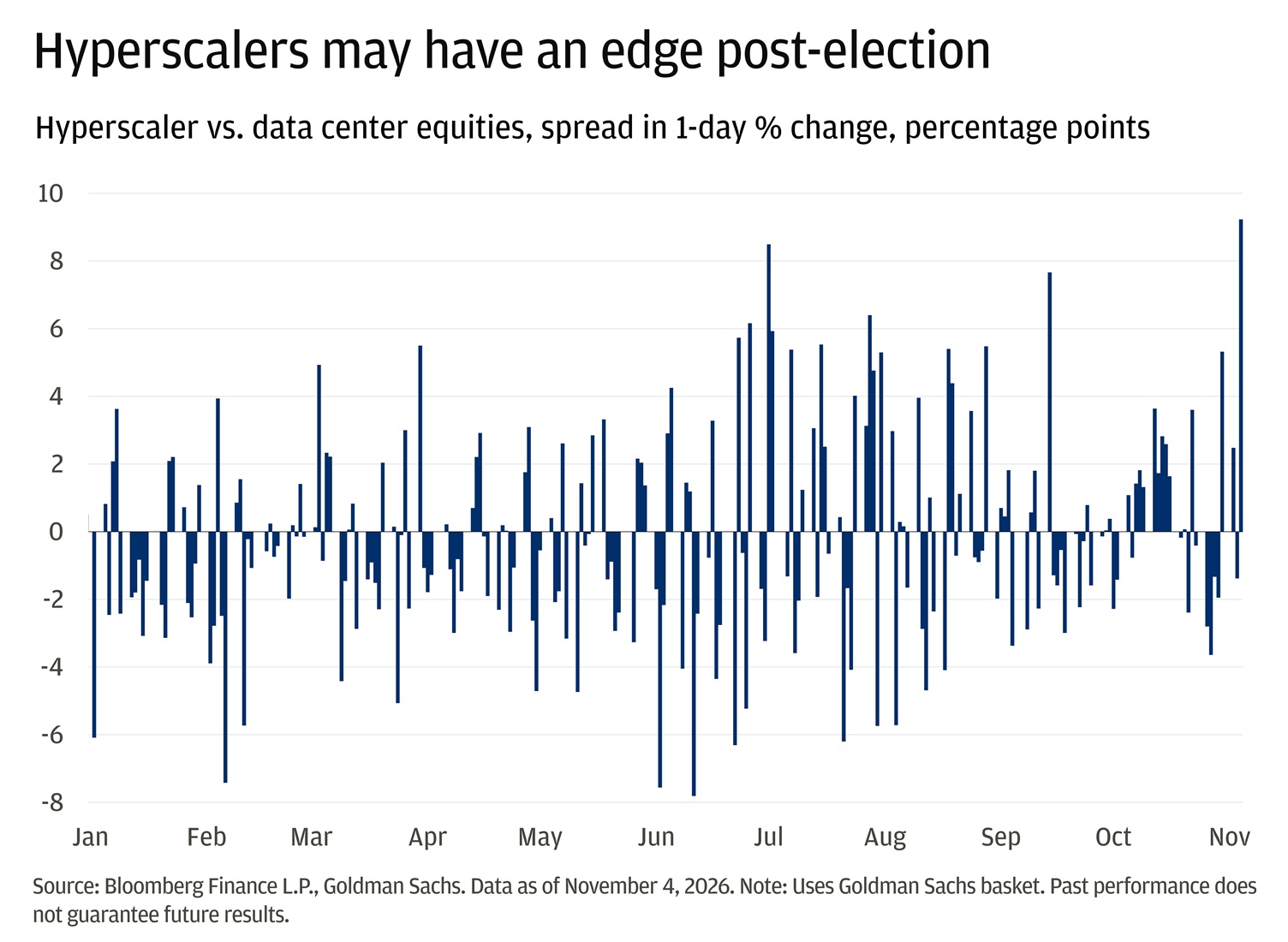
In an environment where regulation could change even in the most AI-friendly states, companies with existing compute and data center projects – like the hyperscalers – have the edge. Plus, additional regulatory proposals target new developments, not existing ones. That could strengthen the position of companies with operational data centers, secured power and established customers. Combined with any potential moderation in AI growth and the ability to meet greater construction and permitting standards, the established lead that some of the biggest tech companies have is even more beneficial relative to the parts of the tech trade that rely on the incremental buildout.

And that’s something investors are already pricing, sending the message that owning productive capacity today is different from depending on its construction tomorrow – even if that means factoring in potential regulatory risk.

This line chart shows the daily spread in percentage points between hyperscaler and data center equities, measured as the difference in 1-day percent change throughout the year.


Pain in ‘picks and shovels’

Before the policy details have even been settled, or formally proposed, investors have already repriced these possibilities. It’s most visible in parts of the “picks and shovels” AI infrastructure trade – the part of the market that rallied on the certainty of the buildout even as the return on investment remains in question.

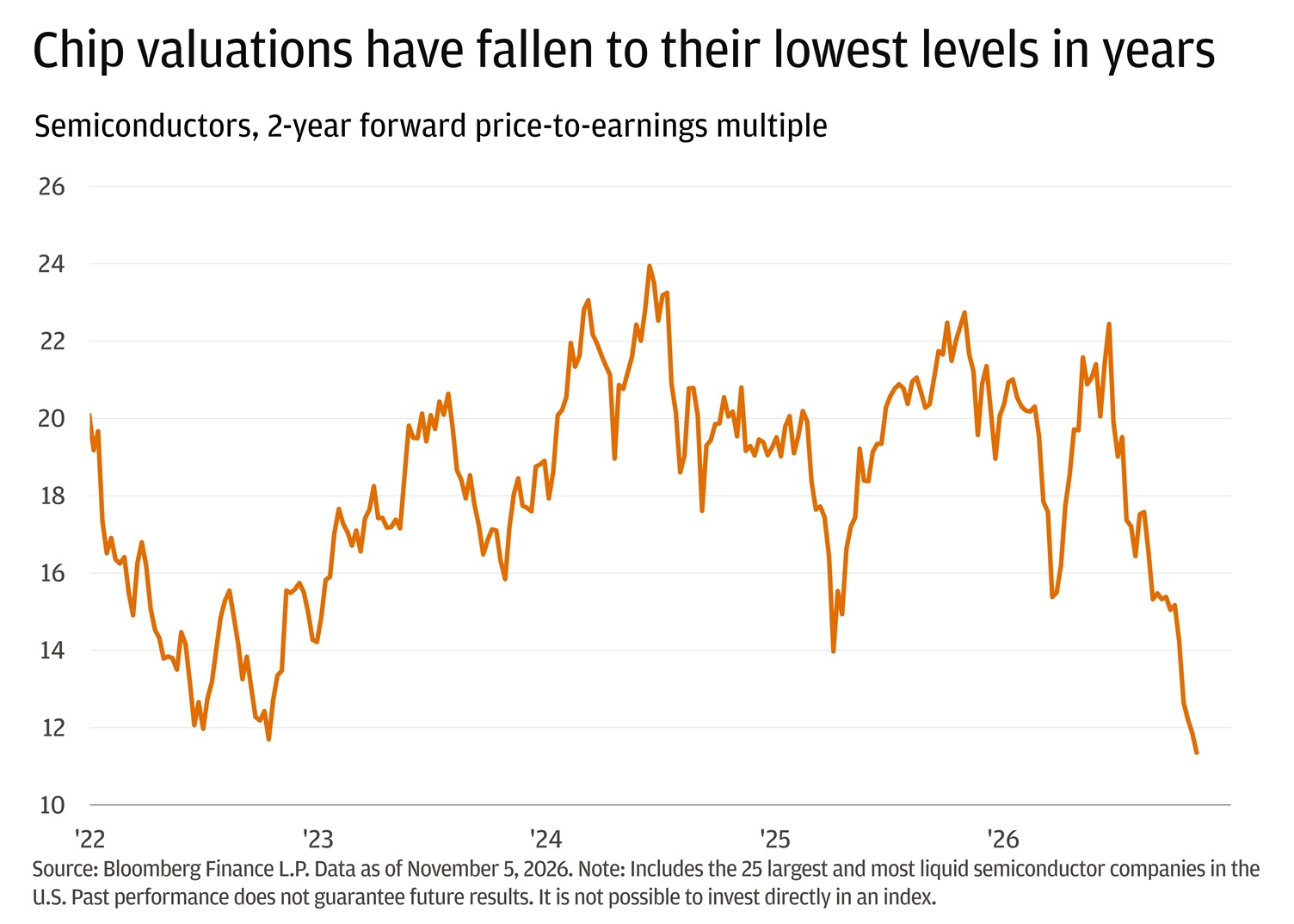
The 24-month forward price-to-earnings ratio of the MVIS US Listed Semiconductor 25 Index has halved since June. After trading at a peak of 22.5 times forward earnings in June, the index currently trades at 11.4 times forward earnings. That’s at a valuation lower than when investors were digesting the beginning of the conflict in Iran, “Liberation Day” and the stock market lows of 2022. It reflects a market questioning the durability of the industry’s earnings and continued growth in capital expenditures.


This line chart shows the 2-year forward price-to-earnings multiple for semiconductors, tracking the valuation of the 25 largest and most liquid U.S. semiconductor companies from 2022 through 2026.


But that’s where the opportunity may lie. Yes, regulation is subject to change, but the scale of economic growth that has come from this sector alone may bear some impact on the level and willingness to limit continued development.

The AI trade is far from over, but it is evolving. Financing, regulatory and power constraints can mean a bumpy road ahead, but unless end demand falters, the risk of an inventory overhang and earnings slowdown may already be baked into valuations. As the structural backdrop of the AI buildout remains in place, the key is to determine which companies have the lead in an undeniable technological evolution that can broaden out in the years to come.

All market and economic data as of 11/05/2026 are sourced from Bloomberg Finance L.P. and FactSet unless otherwise stated.

Connect with a Wealth Advisor

Reach out to your Wealth Advisor to discuss any considerations for your current portfolio. If you don’t have a Wealth Advisor, click here to tell us about your needs and we’ll reach out to you.

Connect now


Important Information

Index definitions:

The S&P 500 Index is an unmanaged broad-based index that is used as representation of the U.S. stock market. It includes 500 widely held common stocks. Total return figures reflect the reinvestment of dividends. “S&P500” is a trademark of Standard and Poor’s Corporation.

We believe the information contained in this material to be reliable but do not warrant its accuracy or completeness. Opinions, estimates, and investment strategies and views expressed in this document constitute our judgment based on current market conditions and are subject to change without notice.

The views, opinions, estimates and strategies expressed herein constitutes the author's judgment based on current market conditions and are subject to change without notice, and may differ from those expressed by other areas of J.P. Morgan. This information in no way constitutes J.P. Morgan Research and should not be treated as such. You should carefully consider your needs and objectives before making any decisions. For additional guidance on how this information should be applied to your situation, you should consult your advisor.

Any companies referenced are shown for illustrative purposes only, and are not intended as a recommendation or endorsement by J.P. Morgan in this context.

JPMorgan Chase & Co., its affiliates, and employees do not provide tax, legal or accounting advice. Information presented on these webpages is not intended to provide, and should not be relied on for tax, legal and accounting advice. You should consult your own tax, legal and accounting advisors before engaging in any financial transaction.

RISK CONSIDERATIONS 

  • Past performance is no guarantee of future results. It is not possible to invest directly in an index.
  • The price of equity securities may rise or fall due to the changes in the broad market or changes in a company's financial condition, sometimes rapidly or unpredictably. Share values can rise with strong earnings or positive market expectations, but they can also fall due to weak earnings or negative sentiment, and dividends are not guaranteed.
  • Investing in fixed income products (such as bonds) is subject to certain risks, including, but not limited to, interest rate, credit, inflation, call, default, prepayment and reinvestment risk. Any fixed income security sold or redeemed prior to maturity may be subject to substantial gain or loss.
  • Investors should carefully read the prospectus or other offering documents which include information on the investment objectives, risks, charges and expenses along with other information about the fund before investing.
  • Investors should understand the potential tax liabilities surrounding a municipal bond purchase. Certain municipal bonds are federally taxed if the holder is subject to alternative minimum tax. Capital gains, if any, are federally taxable. The investor should note that the income from tax-free municipal bond funds may be subject to state and local taxation and the alternative minimum tax (AMT).
  • International investments may not be suitable for all investors. International investing involves a greater degree of risk and increased volatility. Some international markets may not be politically or economically stable. Foreign holdings are subject to currency risk, as fluctuations in exchange rates between the investment’s foreign currency and the holder’s domestic currency can affect the value of the investment.           
  • Investing in emerging markets involves a greater degree of risk and increased volatility compared to developed markets. Changes in currency exchange rates and differences in accounting and taxation policies outside the investor’s jurisdiction can raise or lower returns. Some markets may not be as politically and economically stable, in addition to differences in taxation policies, and legal systems outside the investor’s jurisdiction may create additional risks. Investors should carefully consider these risks and consult with financial and legal advisors before investing in emerging markets.
  • Investments in commodities may have greater volatility than investments in traditional securities, particularly if the instruments involve leverage. The value of commodity-linked derivative instruments may be affected by changes in overall market movements, commodity index volatility, changes in interest rates, or factors affecting a particular industry or commodity, such as drought, floods, weather, livestock disease, embargoes, tariffs and international economic, political and regulatory developments. Use of leveraged commodity-linked derivatives creates an opportunity for increased return but, at the same time, creates the possibility for greater loss.     
  • Real Estate Investment Trusts (REITs) are subject to risks such as fluctuations in property values and changes in economic conditions. Additionally, REITs may face risks from interest rate changes, regulatory shifts, and limited diversification if concentrated in specific sectors or geographic areas.
  • Investing in alternative assets involves higher risks than traditional investments, including, without limitation, limited liquidity and valuation risk, and is suitable only for investors with sufficient knowledge and sophistication to evaluate the merits and risks of such investments. Alternative investments should not be deemed a complete investment program and distributions are not guaranteed. They may not be tax efficient, and an investor should consult with their tax professional prior to investing. Alternative investments often have higher fees than traditional investments and they may also be highly leveraged and engage in speculative investment techniques, which can magnify the investment loss or gain--including risk of loss of the entire investment. For comprehensive details around unique set of risks for specific alternative investments, please consult the offering memorandum.
  • Structured product involves derivatives and intended for experienced and sophisticated investors who are willing to bear the high economic risks of the investment. The most common risks include, but are not limited to, risk of adverse or unanticipated market developments, issuer credit quality risk, risk of lack of uniform standard pricing, risk of adverse events involving any underlying reference obligations, risk of high volatility, risk of illiquidity/little to no secondary market, and conflicts of interest. Any payments on a structured product are subject to the credit risk of the issuer and/or guarantor. Investors may lose their entire investment, i.e., incur an unlimited loss. Before investing in a structured product, investors should review the accompanying offering document, prospectus or prospectus supplement to understand the actual terms and key risks associated with each individual structured product. For a more comprehensive list of the risks involved with a particular product, please refer to the relevant risk disclosure booklet or speak to your J.P. Morgan team.  If you are in any doubt about the risks involved in the product, you may clarify with the intermediary or seek independent professional advice.
  • Private investment funds (including, without limitation, hedge funds, funds of hedge funds, private equity funds, real estate funds, etc.) are subject to special risks, including risk of loss of the entire investment and is suitable only for investors with sufficient knowledge and sophistication to evaluate the merits and risks of such investments. As a reminder, private investment funds often engage in leveraging and other speculative investment practices that may increase the risk of investment loss. These investments can be highly illiquid, and may not be required to provide periodic pricing or valuation information to investors, and may involve complex tax structures and delays in distributing important tax information. Distributions are not guaranteed and may be modified at the Fund Board’s discretion. These investments are not subject to the same regulatory requirements as mutual funds; and often charge high fees (performance fees in addition to management fees). Further, any number of conflicts of interest may exist in the context of the management and/or operation of any such fund. For comprehensive details around unique set of risks for specific alternative investments, please refer to the applicable offering memorandum.
  • Investments in digital assets and cryptocurrencies, or other investment vehicles holding or referencing digital assets, are highly speculative and involve significant risks, including, but not limited to, increased volatility, ongoing regulatory uncertainty including lack of clear precedent in various jurisdictions surrounding digital assets, cybersecurity risk relating to digital asset holdings, and increased sensitivity to news, speculation and manipulation. Likewise, various digital assets may differ from one another in their technological characteristics, regulatory treatment, market convention and performance. There is limited data on the performance of digital assets and products referencing digital assets (although in no case should historical performance be taken as an indication of future performance). You should consider these unique characteristics and whether these assets are suitable for you when making an investment decision.
  • The prices and rates of return are indicative, as they may vary over time based on market conditions.
  • Additional risk considerations exist for all strategies.
  • The information provided herein is not intended as a recommendation of or an offer or solicitation to purchase or sell any investment product or service.
  • Opinions expressed herein may differ from the opinions expressed by other areas of J.P. Morgan. This material should not be regarded as investment research or a J.P. Morgan investment research report.


GENERAL RISKS & CONSIDERATIONS
. 
Any views, strategies or products discussed in this material may not be appropriate for all individuals and are subject to risks. Investors may get back less than they invested, and past performance is not a reliable indicator of future results. Asset allocation/diversification does not guarantee a profit or protect against loss. Nothing in this material should be relied upon in isolation for the purpose of making an investment decision. You are urged to consider carefully whether the services, products, asset classes (e.g. equities, fixed income, alternative investments, commodities, etc.) or strategies discussed are suitable to your needs. You must also consider the objectives, risks, charges, and expenses associated with an investment service, product or strategy prior to making an investment decision. For this and more complete information, including discussion of your goals/situation, contact your J.P. Morgan representative.

NON-RELIANCE. Certain information contained in this material is believed to be reliable; however, JPM does not represent or warrant its accuracy, reliability or completeness, or accept any liability for any loss or damage (whether direct or indirect) arising out of the use of all or any part of this material. No representation or warranty should be made with regard to any computations, graphs, tables, diagrams or commentary in this material, which are provided for illustration/reference purposes only. The views, opinions, estimates and strategies expressed in this material constitute our judgment based on current market conditions and are subject to change without notice. JPM assumes no duty to update any information in this material in the event that such information changes. Views, opinions, estimates and strategies expressed herein may differ from those expressed by other areas of JPM, views expressed for other purposes or in other contexts, and this material should not be regarded as a research report. Any projected results and risks are based solely on hypothetical examples cited, and actual results and risks will vary depending on specific circumstances. Forward-looking statements should not be considered as guarantees or predictions of future events.

Nothing in this document shall be construed as giving rise to any duty of care owed to, or advisory relationship with, you or any third party. Nothing in this document shall be regarded as an offer, solicitation, recommendation or advice (whether financial, accounting, legal, tax or other) given by J.P. Morgan and/or its officers or employees, irrespective of whether or not such communication was given at your request. J.P. Morgan and its affiliates and employees do not provide tax, legal or accounting advice. You should consult your own tax, legal and accounting advisors before engaging in any financial transactions.

Legal Entity and Regulatory Information.

J.P. Morgan Wealth Management is a business of JPMorgan Chase & Co., which offers investment products and services through J.P. Morgan Securities LLC (JPMS), a registered broker-dealer and investment adviser, member FINRA and SIPC. Insurance products are made available through Chase Insurance Agency, Inc. (CIA), a licensed insurance agency, doing business as Chase Insurance Agency Services, Inc. in Florida. Certain custody and other services are provided by JPMorgan Chase Bank, N.A. (JPMCB). JPMS, CIA and JPMCB are affiliated companies under the common control of JPMorgan Chase & Co. Products not available in all states.

Bank deposit accounts and related services, such as checking, savings and bank lending, are offered by JPMorgan Chase Bank, N.A. Member FDIC.

This document may provide information about the brokerage and investment advisory services provided by J.P. Morgan Securities LLC (“JPMS”). The agreements entered into with JPMS, and corresponding disclosures provided with respect to the different products and services provided by JPMS (including our Form ADV disclosure brochure, if and when applicable), contain important information about the capacity in which we will be acting. You should read them all carefully. We encourage clients to speak to their JPMS representative regarding the nature of the products and services and to ask any questions they may have about the difference between brokerage and investment advisory services, including the obligation to disclose conflicts of interests and to act in the best interests of our clients.

J.P. Morgan may hold a position for itself or our other clients which may not be consistent with the information, opinions, estimates, investment strategies or views expressed in this document. JPMorgan Chase & Co. or its affiliates may hold a position or act as market maker in the financial instruments of any issuer discussed herein or act as an underwriter, placement agent, advisor or lender to such issuer.