
Contributors

Sitara Sundar

Head of Alternative Investment Strategy & Market Intelligence, J.P. Morgan Private Bank

2025 marked a year of robust returns in the face of uncertainty – global equities were up over 20%, global fixed income meaningfully outperformed cash and commodities posted their strongest return since 2022. While we remain constructive on the outlook for markets and the economy in 2026, tensions linger beneath the surface.

Equity market concentration is at all-time highs amid elevated valuations. Credit spreads are the tightest they’ve been in years. Economic nationalism and fiscal activism have reignited risks of inflation and interest rate volatility, making positive stock-bond correlation more likely.

That means the old diversification playbook may not be as reliable as it used to be – the traditional 60/40 portfolio may be less likely to provide the stability investors seek to grow their wealth across market cycles. That’s where alternative investments may have a role. Many investors treat alternatives as a tactical portfolio add-on, but we believe they’re a strategic consideration for building resilient portfolios.

We think compelling opportunities in alternatives are centered on three investment themes:

  • The next phase of artificial intelligence (AI)
  • The quest for portfolio durability
  • The evolving liquidity of private markets

Here is how these themes are reshaping the alternatives opportunity set in 2026.

Theme 1: The next phase of AI: Power, energy, AI applications

Over the past three years, companies have committed a meaningful amount of capital expenditure (capex) to building the physical and digital infrastructure needed to support AI’s advancement. We believe the next phase of AI will be defined by solving bottlenecks in power and energy and unlocking value through real-world integration of applications. We also find that private markets are where these innovations are happening.

Surging demand for power at a time of supply constraints, multiyear transmission backlogs, aging infrastructure and resource scarcity (minerals, water) are re-emerging as hard limits to the growth in AI. They are also straining electricity grids, undercutting their reliability and putting upward pressure on power prices.1

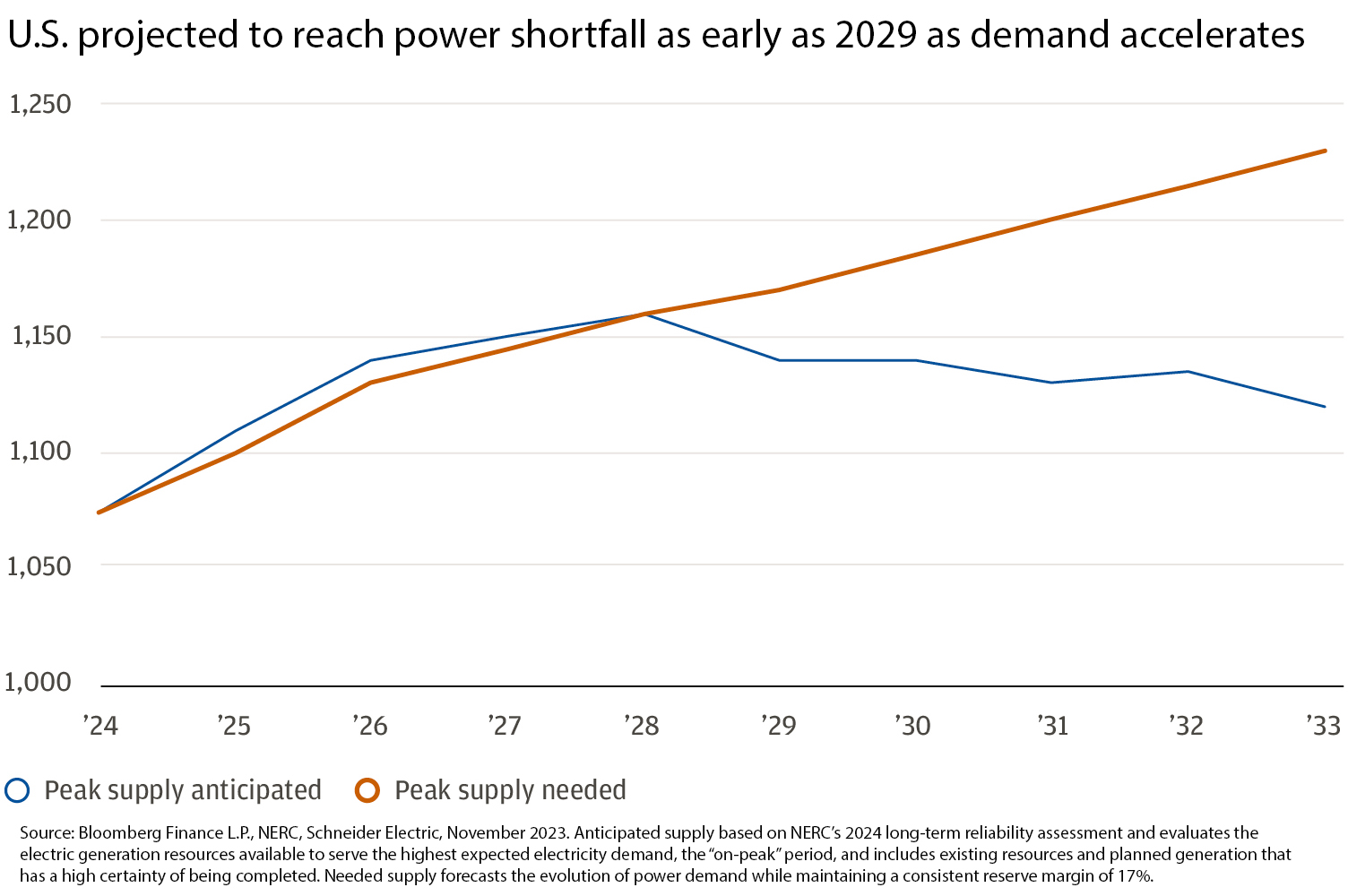
Indeed, the U.S. may reach a power shortfall as early as 2029. This will require investment not only in power infrastructure – generation, transmission and distribution – but also in energy efficiency and infrastructure that improves reliability and reduces peak-load stress, expanding the opportunity set for investors. For example, in the U.S., this is likely to support sustained demand for oil and natural gas, creating secular tailwinds at a time when fundamentals are improving and valuations remain attractive.2

But this is not just a U.S. phenomenon. Globally, electrification, AI-driven load growth and aging grid infrastructure are converging to create similar reliability and capacity constraints, making investment in both firm energy supply and grid efficiency a worldwide imperative.

Line chart showing projected difference between the United States’ electricity supply and demand from 2024 to 2033.

AI companies are also developing applications that improve their customers’ growth potential, delivering productivity, revenue and in some cases profitability gains. Agentic AI has the potential to make decisions and operate independently of constant human input. AI-enabled enterprise software can automate core business functions. Vertical AI solutions offer purpose-built tools tailored for specific industries. Estimates suggest these could represent a $6 trillion market by 2030.3

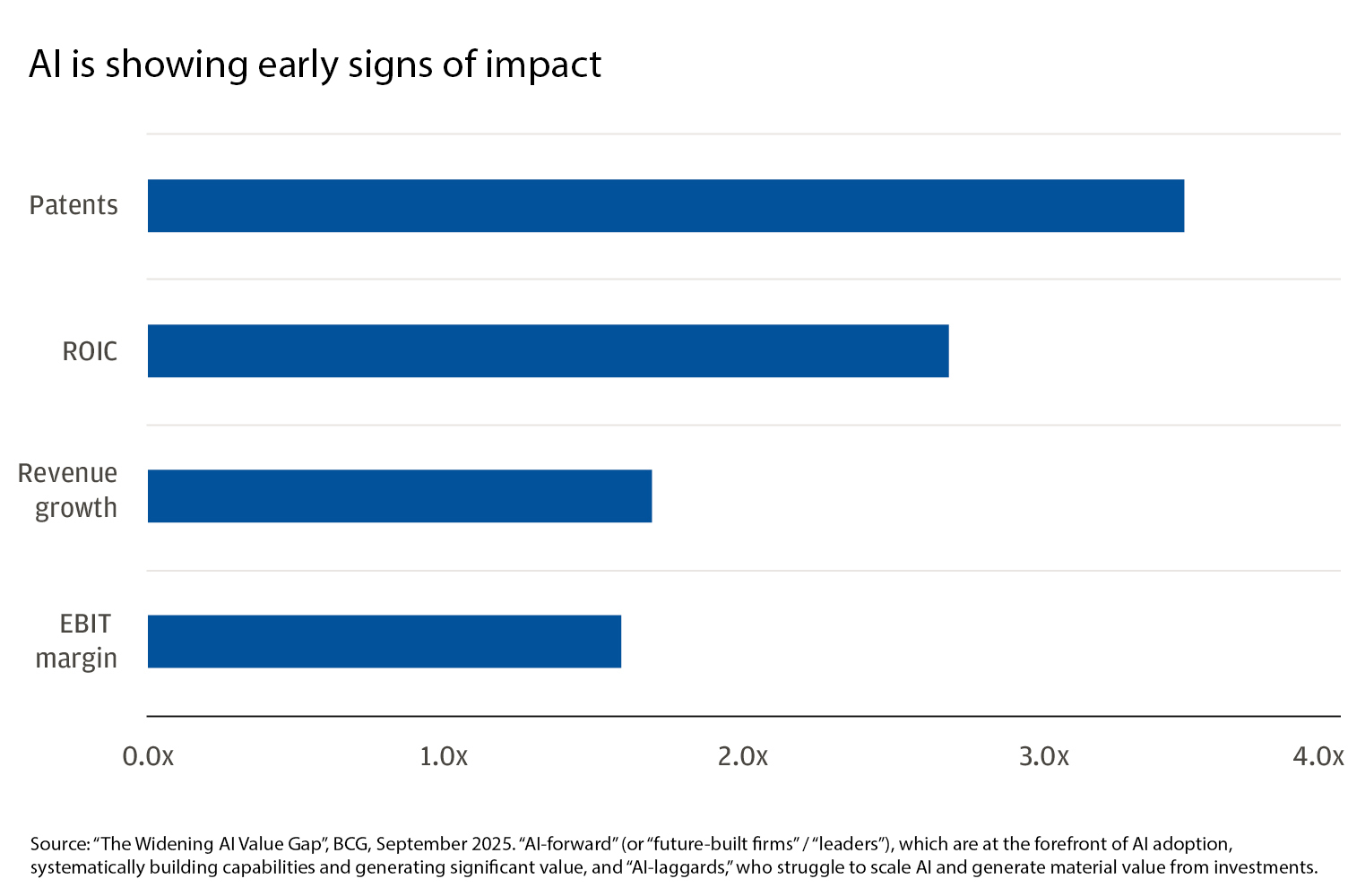
While it is still early days, one study found that AI-forward companies are growing revenues 1.7 times faster than AI laggards and expanding margins 1.6 times faster. Should this trend continue to materialize, investors may start to punish the laggards, especially heritage software companies they perceive are not evolving quickly enough to benefit from AI.

Bar chart showing early impact of artificial intelligence (AI) on business performance.

But the most important takeaway for investors is this: The majority of applications are currently emerging primarily in private markets. Investors could be missing meaningful growth and innovation opportunities if they don’t have exposure to private markets through venture capital and private equity.

Here’s how investors may consider accessing these opportunities:

  • Agentic AI: Best suited for venture capital funds. Agentic AI is still in an experimental and fast-evolving phase, requiring patient capital, long research and development (R&D) cycles, and risk-tolerant backing.
  • Vertical AI solutions: We believe both venture capital and growth equity managers will play critical roles supporting early-stage innovation, especially where a product’s fit for its market, and its distribution, are still being tested. Growth equity should also be crucial in helping proven companies scale up, professionalize and find more customers.
  • AI-enabled enterprise software: Growth equity and buyout investors will likely provide the operational expertise, capital and strategic discipline to help AI-enabled software platforms scale efficiently.

To be sure, three years into the AI cycle, some isolated pockets of froth have begun bubbling up. We expect ebbs and flows in the sector’s fortunes over the next decade, and we’re carefully monitoring for signs of a bubble – but we continue to believe our clients face greater risk from underexposure, not overexposure.

Theme 2: The quest for portfolio durability

Building a resilient portfolio today means going beyond traditional equities and bonds. With “tech plus”4 now making up nearly 50% of the U.S. equity market, leaning into less correlated, differentiated return streams is more important than ever.

For those seeking greater portfolio durability in 2026, we favor core private equity (leaning on geographic and sector diversification), “diversifying the diversifiers” through hedge funds and infrastructure, and complementing senior secured direct lending with other pockets of credit. Careful manager selection will be critical across the board as dispersion widens.

Core private equity

Core private equity (PE) may play a critical role in portfolios in 2026 and beyond as a source of differentiated returns. To boot – we believe returns will be supported by robust earnings growth, resurgence in dealmaking activity as financial conditions ease and a revitalization of the PE playbook (e.g. carve-outs, operational improvements).

Geographic diversification is critical

We are constructive on Europe, India and Japan. While European public markets have lagged U.S. public markets for over a decade, the median European PE buyout fund has outperformed its U.S. peers and the public market benchmark.5 Europe’s fragmented markets, operational complexity, abundance of middle market companies and fewer funds in competition are driving this trend. European buyout funds should continue offering investors greater exposure to long-term themes than public markets do: Tech and telecom account for about one-third of deal activity versus roughly one-tenth of the MSCI Europe companies’ market cap.6

India is one of the Asia-Pacific region’s fastest-growing PE markets. Deal activity continues to accelerate, driven by strong economic growth, rising consumer demand, global supply chain shifts and burgeoning institutional interest. In Japan, corporate carve-outs – firms spinning off a division or business unit – and corporate governance reforms accelerate deal activity.

Sector diversification

We favor health care and security alongside traditional tech. While we remain constructive on tech PE given the opportunity in AI, there is meaningful innovation in health care, including precision medicine and advanced diagnostics. Security themes, such as energy security, supply chain resilience and defense technology, are a growing opportunity. Sports may have potential to provide a source of robust returns that are less correlated to public markets.

Diversifying the diversifiers

Hedge funds and infrastructure can help buffer against the risk of equity market concentration and higher likelihood of positive stock-bond correlations.

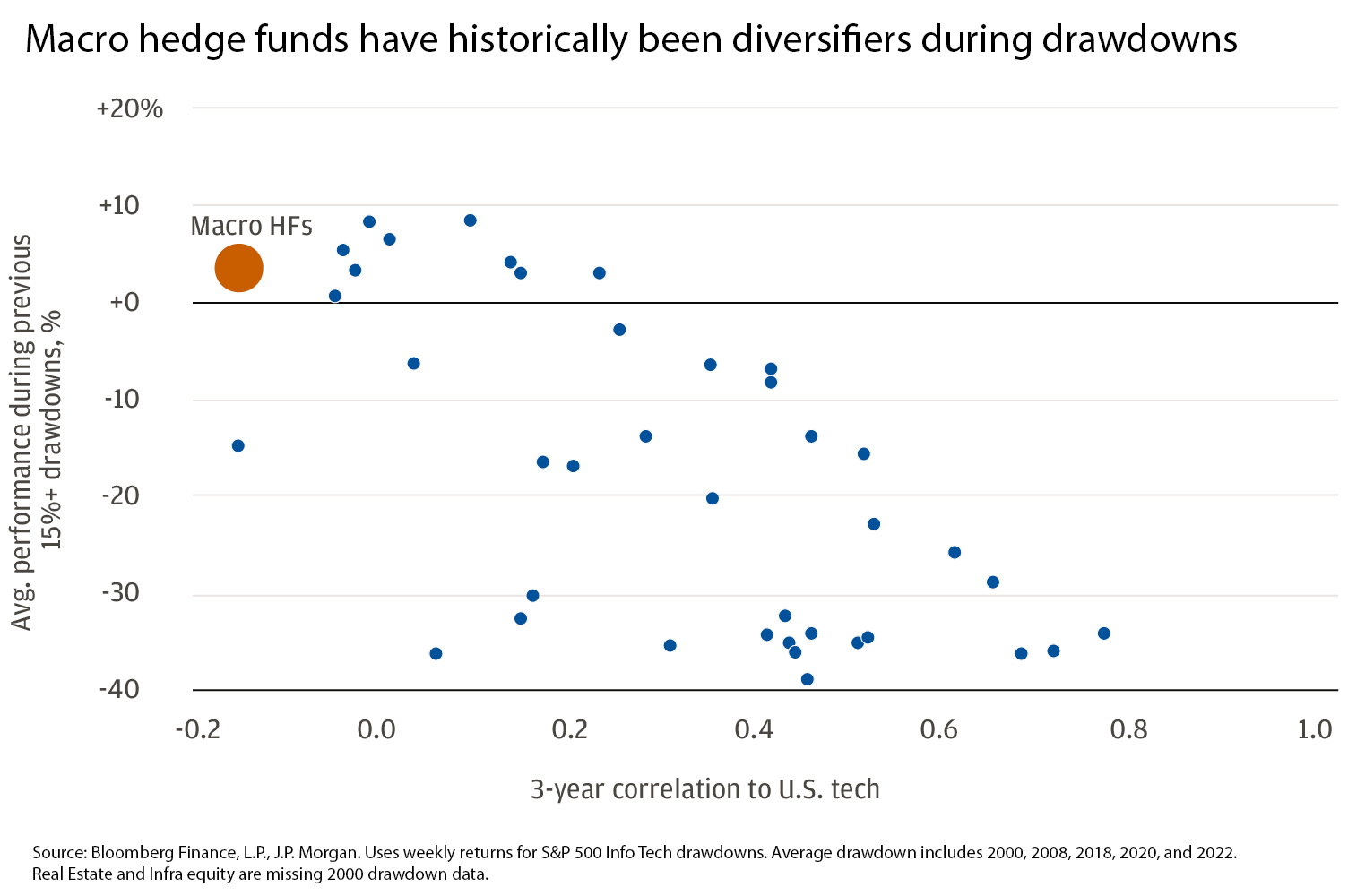
Hedge funds delivered in 2025. Seven out of eight hedge fund segments7 were in the green, and discretionary macro hedge funds gained over 10%,8 outpacing traditional fixed income. Macro hedge funds in particular have been a critical diversifier – negatively correlated to both tech stocks and the 60/40 portfolio while also providing positive returns during major market drawdowns.

We anticipate this pattern to continue, given prevailing conditions of elevated rates, volatility and performance dispersion by sectors and assets that create more chances for hedge fund managers to find opportunities in mispricings. Importantly, hedge funds can give investors the opportunity to diversify without sacrificing absolute returns.

Scatter plot showing relationship between the average performance of various asset classes during significant S&P 500 Information Technology drawdowns.

Infrastructure also stands out: As of December, yields averaged around 6%, about 2 percentage points above the 10-year Treasury. Infrastructure returns have been historically consistent during inflation regimes, are backed by multiyear cash flows and are supported by a long-term trend: Resilient infrastructure is now a matter of national security.

Credit complements

We expect direct lending9 yields in the United States to return to historical ranges (8%–10%). Within direct lending, we prefer higher-quality loans at the top of the capital structure (senior-secured) and larger company borrowers (EBITDA over $50 million). Europe is starting to look more attractive: The market is less trafficked, lenders face less competition from banks and yields maintain a healthy premium over public credit markets. Overall, we expect performance dispersion in this space to widen in 2026, so manager selection is critical.

We believe complementing direct lending with other pockets of credit will be critical to portfolios in 2026 and beyond as yields normalize and pockets of stress emerge. Consider asset-backed credit, which offers higher yields than public markets, supported by an illiquidity (complexity) premium, a large total addressable market (TAM),10 less competition and a diversified collateral pool. Another diversification option: real estate.

Also consider taking advantage of “micro” credit cycles that emerge in 2026 as growth may be uneven across industries and disruption from AI creates cracks in pockets of software,11 through opportunistic/distressed credit managers that seek out dislocations.

Theme 3: The evolving liquidity of private markets

Private market liquidity is evolving fast.

Evergreen fund structures will likely alter the private market landscape. As of 2025, around 20% of our private bank alternative investment assets under supervisory were in evergreen vehicles (four times the level five years ago).

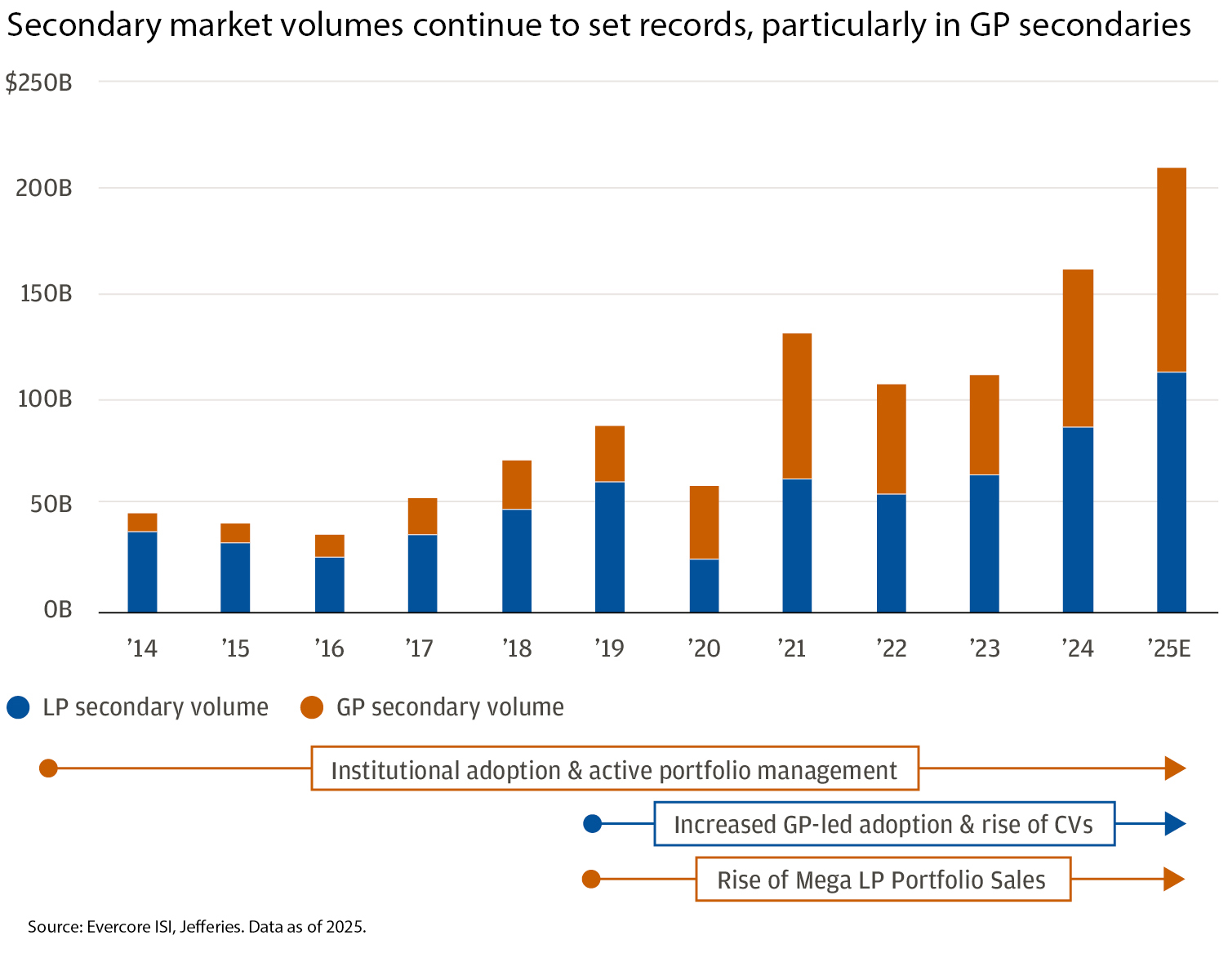
As private markets mature, we expect asset owners will find more opportunities for liquidity beyond the traditional avenues of initial public offerings (IPOs) and strategic mergers and acquisitions (M&A). Secondary markets12 are a key part of this maturation as private equity assets continue to age. The median holding period for global buyout PE funds is elevated (at more than six years). Continuation vehicles, which are new funds created by PE general partners to hold portfolio companies, now account for nearly 20% of global PE exits.13

These structural shifts are unlocking new ways for limited partners (LPs) and general partners (GPs) to manage liquidity and add diversification to portfolios.

Where are the opportunities?

  • LP-led secondaries: Institutions’ growing adoption of these transactions, and active portfolio management, are driving increased volume in secondaries. This market offers investors access to seasoned, diversified portfolios with shorter duration and greater cash flow visibility than traditional core PE.
  • GP stakes and solutions: The prevalence and value of GP solutions – such as GP stakes and continuation vehicles – are trending higher. We believe there is a growing opportunity in GP-led secondaries as market growth accelerates. GP stakes provide investors access to the institutionalization and scaling of alternative asset managers.
  • Secondary specialists: Secondaries are moving beyond private equity – we believe there is a growing opportunity set in venture capital (VC) and infrastructure markets. Some estimates show that by 2030, VC and growth LP secondaries will surpass $100 billion TAM,14 and infrastructure secondary volumes could triple to about $30 billion.
Bar chart showing growth of secondary market volumes in private equity from 2014 through an estimate for 2025.

The private market liquidity landscape continues to evolve, driven by aging assets and growing evergreen funds. Investors should consider maintaining a balance between drawdown and evergreen structures as they build out their private equity portfolios, while also exploring investments in secondaries.

The bottom line: Alternatives as features of dynamic, resilient portfolios

The promise and pressure of 2026 are not about chasing the next rally or hedging against the next drawdown. They are in recognizing that so many old boundaries have collapsed – between public and private, between equity and alternatives, between efficiency and resilience.

To us, this means alternatives are an important consideration. We believe in the uncomfortable truth, that the risks of concentration and correlation are rising. Portfolios allocated strictly to stocks and bonds may run the risk of obsolescence. The way forward is to build portfolios as dynamic, resilient and innovative as the world they must navigate.

References

1.

Utility PJM reported that in the latest power auction, the clearing price for 2026–27 delivery to its customers was capped at $329/MW-day, 330% higher than the 2015–24 median price.

2.

Free Cash Flow Yields are now ~7% for US exploration & production companies (vs ~4% a decade ago); valuations are now ~3.5x EV / NTM EBITDA (vs 6.7x a decade ago). Source: Bloomberg Finance L.P., FactSet, Company Filings, December 2025.

3.

Bain & Company, Vista, Q4 2025.

4.

Tech plus is defined as info tech plus Google, Amazon, Meta and Tesla.

5.

MSCI Europe.

6.

Preqin, Bloomberg, December 2025.

7.

The eight hedge fund segments are long/short, event driven, global macro, relative value, multi strategy, relative value arbitrage, systematic-quantitative and credit strategies.

8.

Goldman Sachs Prime Brokerage, latest as of December 2025.

9.

Typically customized loans by investment firms, provided loans directly to companies—usually private and/or mid-sized—offering creditors higher returns but greater risk and less liquidity than with traditional bank syndicates issuing publicly traded bonds.

10.

TAM, or total addressable market, is the theoretical total revenue opportunity, should a product or service achieve 100% market share: the theoretical maximum potential. TAM is used to estimate business growth potential.

11.

Short-term fluctuations in availability, cost or terms of credit driven by economic, borrower or investor conditions, occurring within a broader, longer-term credit cycle. May last from several months to a few years.

12.

Secondary transactions (secondaries) are existing PE fund investors’ commitments in private companies bought and sold; unlike a "primary" investment in which capital is initially committed. The secondary market allows limited partners (LPs) to sell their interests before the fund reaches maturity, providing liquidity in a typically illiquid asset class. Buyers are typically institutional investors, secondary funds or other LPs. General partner (GP) secondary transactions are also growing.

13.

Michael Cembalest, J.P. Morgan Private Bank, “The Deep End: 2025 Alternative Investments Review”, (December 2, 2025)

14.

PineGrove, Ardian, latest available as of December 2025.

Connect with a Wealth Advisor

Reach out to your Wealth Advisor to discuss any considerations for your current portfolio. If you don’t have a Wealth Advisor, click here to tell us about your needs and we’ll reach out to you.

Connect now

IMPORTANT INFORMATION

This material is for informational purposes only, and may inform you of certain products and services offered by J.P. Morgan’s wealth management businesses, part of JPMorgan Chase & Co. (“JPM”). Products and services described, as well as associated fees, charges and interest rates, are subject to change in accordance with the applicable account agreements and may differ among geographic locations. Not all products and services are offered at all locations. If you are a person with a disability and need additional support accessing this material, please contact your J.P. Morgan team or email us at accessibility.support@jpmorgan.com for assistance. Please read all Important Information.

KEY RISKS

Investing in alternative assets involves higher risks than traditional investments and is suitable only for sophisticated investors. Alternative investments involve greater risks than traditional investments and should not be deemed a complete investment program. They are not tax efficient and an investor should consult with his/her tax advisor prior to investing. Alternative investments have higher fees than traditional investments and they may also be highly leveraged and engage in speculative investment techniques, which can magnify the potential for investment loss or gain. The value of the investment may fall as well as rise and investors may get back less than they invested.​

Private credit securities may be illiquid, present significant risks, and may be sold or redeemed at more or less than the original amount invested. There may be a heightened risk that private credit issuers and counterparties will not make payments on securities, repurchase agreements or other investments. Such defaults could result in losses to the strategy. In addition, the credit quality of securities held by the strategy may be lowered if an issuer’s financial condition changes. Lower credit quality may lead to greater volatility in the price of a security and in shares of the strategy. Lower credit quality also may affect liquidity and make it difficult for the strategy to sell the security. Private credit securities may be rated in the lowest investment grade category or not rated. Such securities are considered to have speculative characteristics similar to high yield securities, and issuers of such securities are more vulnerable to changes in economic conditions than issuers of higher-grade securities.​

Real estate, hedge funds, and other private investments may not be suitable for all individual investors, may present significant risks, and may be sold or redeemed at more or less than the original amount invested. Private investments are offered only by offering memoranda, which more fully describe the possible risks. There are no assurances that the stated investment objectives of any investment product will be met.

This material is for informational purposes only, and may inform you of certain products and services offered by private banking businesses, part of JPMorgan Chase & Co. (“JPM”). Products and services described, as well as associated fees, charges and interest rates, are subject to change in accordance with the applicable account agreements and may differ among geographic locations. Not all products and services are offered at all locations. Please read all Important Information.


GENERAL RISKS & CONSIDERATIONS
Any views, strategies or products discussed in this material may not be appropriate for all individuals and are subject to risks. Investors may get back less than they invested, and past performance is not a reliable indicator of future results. Asset allocation/diversification does not guarantee a profit or protect against loss. Nothing in this material should be relied upon in isolation for the purpose of making an investment decision. You are urged to consider carefully whether the services, products, asset classes (e.g. equities, fixed income, alternative investments, commodities, etc.) or strategies discussed are suitable to your needs. You must also consider the objectives, risks, charges, and expenses associated with an investment service, product or strategy prior to making an investment decision. For this and more complete information, including discussion of your goals/situation, contact your J.P. Morgan representative.

NON-RELIANCECertain information contained in this material is believed to be reliable; however, JPM does not represent or warrant its accuracy, reliability or completeness, or accept any liability for any loss or damage (whether direct or indirect) arising out of the use of all or any part of this material. No representation or warranty should be made with regard to any computations, graphs, tables, diagrams or commentary in this material, which are provided for illustration/reference purposes only. The views, opinions, estimates and strategies expressed in this material constitute our judgment based on current market conditions and are subject to change without notice. JPM assumes no duty to update any information in this material in the event that such information changes. Views, opinions, estimates and strategies expressed herein may differ from those expressed by other areas of JPM, views expressed for other purposes or in other contexts, and this material should not be regarded as a research report. Any projected results and risks are based solely on hypothetical examples cited, and actual results and risks will vary depending on specific circumstances. Forward-looking statements should not be considered as guarantees or predictions of future events.

Nothing in this document shall be construed as giving rise to any duty of care owed to, or advisory relationship with, you or any third party. Nothing in this document shall be regarded as an offer, solicitation, recommendation or advice (whether financial, accounting, legal, tax or other) given by J.P. Morgan and/or its officers or employees, irrespective of whether or not such communication was given at your request. J.P. Morgan and its affiliates and employees do not provide tax, legal or accounting advice. You should consult your own tax, legal and accounting advisors before engaging in any financial transactions.

Legal Entity and Regulatory Information.

J.P. Morgan Wealth Management is a business of JPMorgan Chase & Co., which offers investment products and services through J.P. Morgan Securities LLC (JPMS), a registered broker-dealer and investment adviser, member FINRA and SIPC. Insurance products are made available through Chase Insurance Agency, Inc. (CIA), a licensed insurance agency, doing business as Chase Insurance Agency Services, Inc. in Florida. Certain custody and other services are provided by JPMorgan Chase Bank, N.A. (JPMCB). JPMS, CIA and JPMCB are affiliated companies under the common control of JPMorgan Chase & Co. Products not available in all states.

Bank deposit accounts and related services, such as checking, savings and bank lending, are offered by JPMorgan Chase Bank, N.A. Member FDIC.

This document may provide information about the brokerage and investment advisory services provided by J.P. Morgan Securities LLC (“JPMS”). The agreements entered into with JPMS, and corresponding disclosures provided with respect to the different products and services provided by JPMS (including our Form ADV disclosure brochure, if and when applicable), contain important information about the capacity in which we will be acting. You should read them all carefully. We encourage clients to speak to their JPMS representative regarding the nature of the products and services and to ask any questions they may have about the difference between brokerage and investment advisory services, including the obligation to disclose conflicts of interests and to act in the best interests of our clients.

J.P. Morgan may hold a position for itself or our other clients which may not be consistent with the information, opinions, estimates, investment strategies or views expressed in this document.  JPMorgan Chase & Co. or its affiliates may hold a position or act as market maker in the financial instruments of any issuer discussed herein or act as an underwriter, placement agent, advisor or lender to such issuer.